
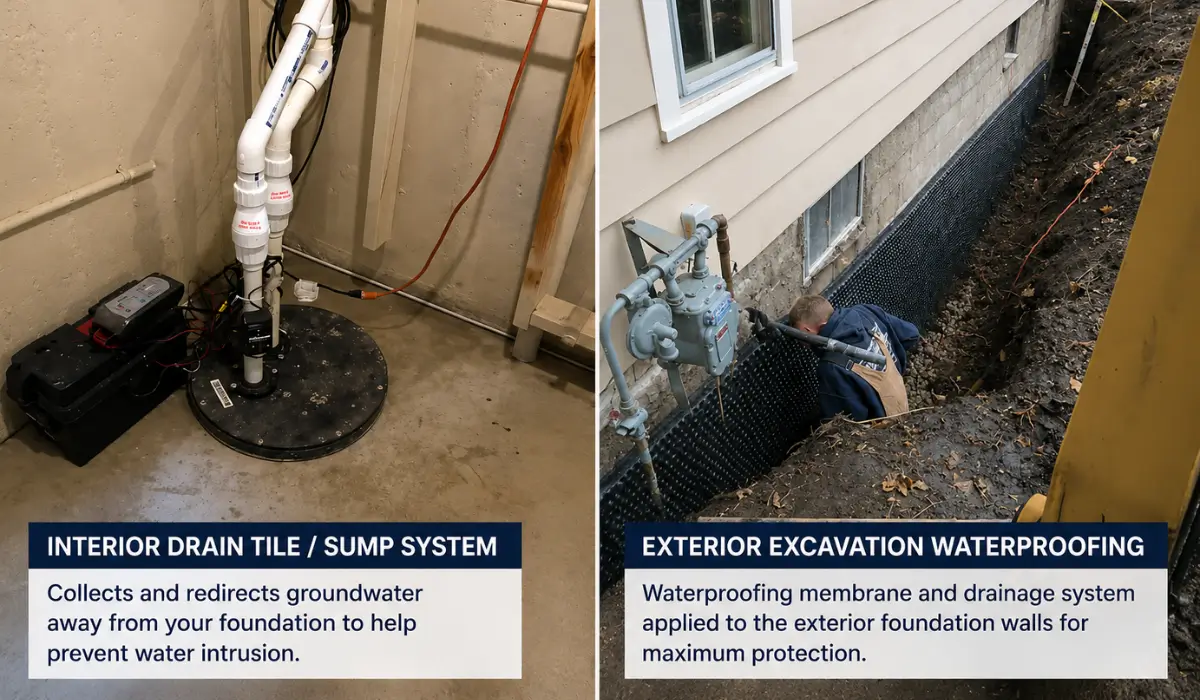
Not all basements need the same waterproofing approach, and choosing the wrong one often leads to repeat problems. Interior vs. exterior waterproofing comes down to where water is entering, how your home was built, and what conditions surround your foundation.
Trying to determine which solution makes sense for your home? This guide will help you identify common water entry points, understand what each waterproofing method is designed to solve, and recognize when a combination approach may provide better long-term protection. Premium Waterproofing has been helping property owners throughout Fox Valley and Northeast Illinois protect their homes from water damage since 1989.
If you’re planning basement improvements, dealing with recurring leaks, or trying to avoid future foundation problems, the information below will help you understand which waterproofing strategy matches your situation.
Two homes on the same street can experience very different basement water problems, even after the same rainstorm. One property may struggle with groundwater pressure beneath the basement floor, while another may have water entering directly through foundation walls.
This is one reason waterproofing recommendations often differ from house to house. The visible symptom may look the same, but the source of the problem can be completely different.
Water can enter a basement through several pathways, and each pathway points toward a different solution. Some people notice seepage where the floor meets the wall, while others find moisture around window wells, foundation cracks, or isolated wall sections.
We regularly inspect homes where previous repairs addressed the visible leak without addressing the reason water was entering. A damp floor seam, a leaking wall crack, and water around a basement window may all require different corrective measures even though they produce similar symptoms.
Homes throughout Northeast Illinois are exposed to changing soil conditions throughout the year. During periods of heavy rainfall, saturated soil can increase pressure against foundation walls. During dry periods, soil movement may contribute to settlement or cracking.
These seasonal changes help explain why some basements remain dry for months before suddenly developing moisture issues. Anyone experiencing recurring water problems should also pay attention to common spring drainage problems, as surface water often plays a larger role than expected.
Throughout Fox Valley and surrounding Northeast Illinois communities, we frequently see water issues develop during seasonal transitions when frozen ground begins to thaw or after prolonged periods of rainfall. Those conditions can increase pressure around foundations and expose drainage weaknesses that may not be noticeable during drier months.
Conditions can vary significantly from one community to another. Our areas we serve includes many of the locations where we regularly inspect basement leaks, drainage issues, and foundation water intrusion.
It’s common to assume the repair that worked for a nearby property will work for another home. In reality, every home responds differently based on drainage patterns, grading, foundation design, soil composition, and construction history.
One property may need an interior drainage system because groundwater pressure is the primary issue. Another may need exterior waterproofing because moisture is penetrating directly through the foundation wall. The most effective repair starts with identifying the source before choosing the solution.
Interior waterproofing is designed to manage water after it reaches the foundation area and safely redirect it away from the basement. Rather than stopping water outside the structure, these systems focus on controlling water before it can accumulate inside the home.
For many properties, interior waterproofing provides an effective way to manage groundwater pressure and reduce recurring basement seepage.
Hydrostatic pressure develops when groundwater accumulates around a foundation and pushes against basement walls and floors. As pressure increases, water naturally seeks the easiest path into the structure.
Interior waterproofing systems are designed to relieve that pressure and control water movement. Many interior basement waterproofing systems include:
These components work together to collect water before it can spread across the basement floor and damage finished or unfinished spaces.
Interior waterproofing often performs best when water intrusion is primarily being driven by groundwater pressure beneath the foundation. Homes that experience seepage along the wall-floor joint are frequently good candidates for interior drainage systems.
Interior systems are commonly recommended when:
Professional basement waterproofing solutions often provide long-term moisture control without requiring extensive excavation around the property.
People searching for interior basement waterproofing near me Downers Grove are often trying to answer the same question: Is water entering because pressure is building beneath the basement floor, because moisture is penetrating through foundation walls, or because both conditions are occurring at the same time?
Understanding what interior waterproofing can and cannot accomplish helps property owners avoid costly assumptions. Interior systems excel at managing groundwater pressure, but they do not prevent moisture from reaching the exterior surface of the foundation wall.
At this point, it often becomes clear that the visible leak is only part of the problem. The more important question is why water is reaching the foundation in the first place and which solution is designed to address that specific condition.
This is also where many temporary fixes fall short. Waterproofing products may stop visible water for a period of time, but lasting results usually depend on understanding how water is moving around the property before selecting a repair strategy.
Even when an interior drainage system is functioning properly, foundation walls can remain exposed to outside moisture. Over time, that repeated exposure can contribute to deterioration, cracking, and long-term foundation concerns that interior systems alone are not designed to address.
Exterior waterproofing focuses on limiting moisture contact before water reaches the structure. Rather than managing water after it arrives, the goal is to reduce exposure before it becomes a basement problem.
Exterior waterproofing systems create a protective layer between the foundation wall and the surrounding soil. Depending on the condition of the property, this process may involve excavation, wall repairs, waterproof membranes, drainage improvements, or protective coatings.
Exterior waterproofing solutions may include:
These measures work together to reduce moisture exposure and help protect the foundation over the long term.
Basement water problems often begin before water ever reaches the foundation wall. Poor grading, clogged drainage paths, low areas around the property, and improper downspout discharge can all direct water toward the structure.
Properties with recurring moisture issues should be evaluated for signs of water collecting near foundations, as surface drainage problems frequently contribute to basement leaks and foundation deterioration.
The U.S. Environmental Protection Agency notes that moisture control is an important part of reducing mold risks and limiting water-related damage. Their mold moisture guidance explains why controlling water around a structure is often more effective than dealing with moisture after it enters the home.
Exterior waterproofing is often recommended when water is penetrating directly through foundation walls or when long-term wall protection is a primary concern. Because excavation is typically involved, a thorough evaluation helps determine whether the investment addresses the actual source of the problem.
Common indicators that exterior waterproofing may be appropriate include:
We evaluate how water is moving around the entire property before recommending excavation. In many cases, correcting drainage issues first helps avoid unnecessary repairs while creating a more effective long-term waterproofing strategy.
At this stage, the problem is no longer just water in the basement. The bigger challenge is understanding why the water is getting there and choosing a waterproofing strategy that addresses the source rather than the symptom.
This is where many repairs succeed or fail. A system can be installed correctly and still produce disappointing results when it was designed to solve the wrong problem. The goal is not to choose between interior and exterior waterproofing first. The goal is to identify how water is reaching the foundation and then match the solution to that condition.
Anyone comparing waterproofing methods can use the decision guide below to narrow the likely source before scheduling a professional evaluation.
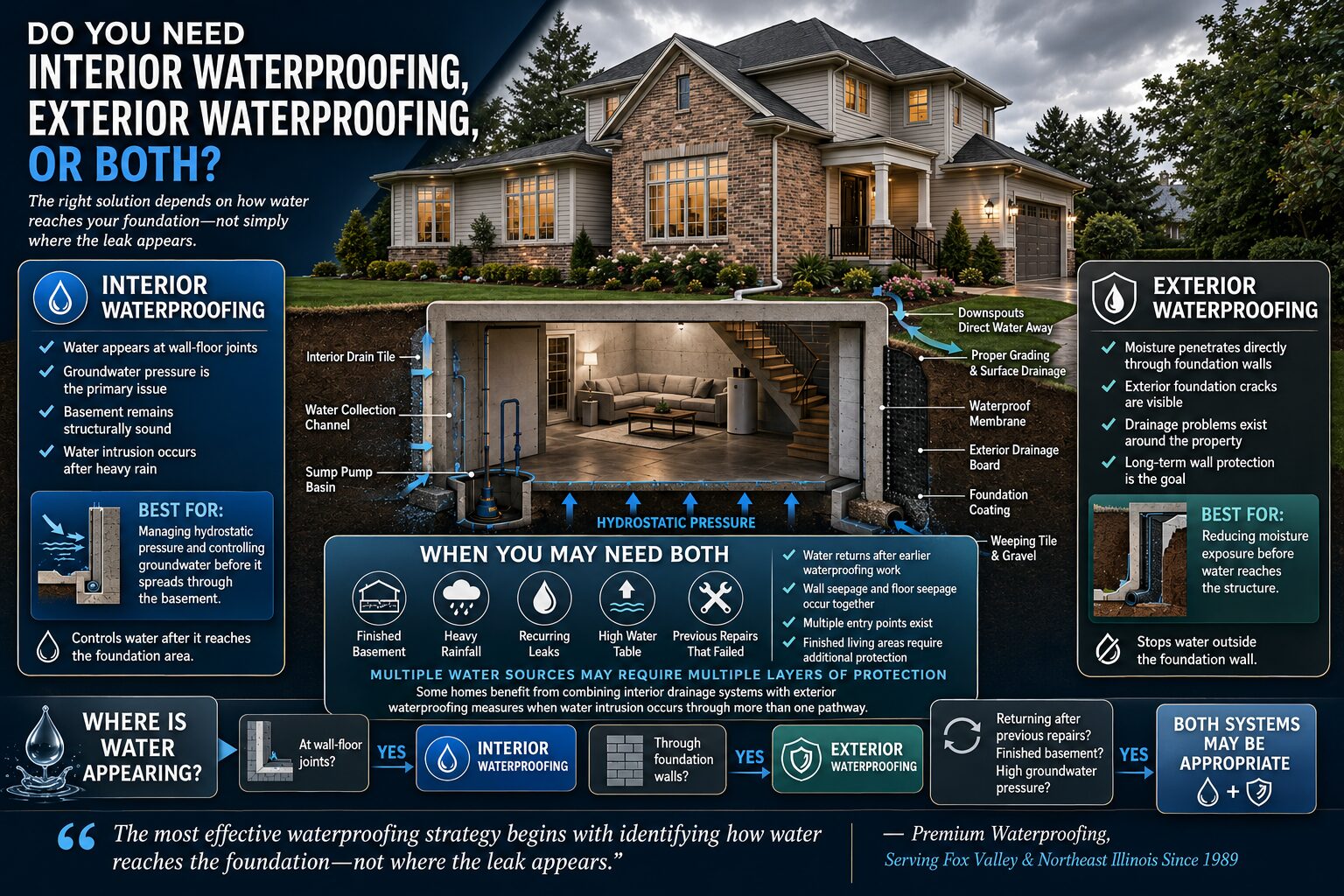
Some waterproofing problems can be solved with a single system, while others require a combination approach because water is entering through multiple pathways or creating more than one type of risk.
Properties with recurring leaks, long-term moisture exposure, or previous waterproofing work that failed to solve the issue often fall into this category. In these situations, addressing one source of water may leave another source untreated.
The decision guide below helps illustrate why two homes with similar symptoms may require completely different waterproofing strategies.
This guide is not intended to replace a professional evaluation. It demonstrates why the correct waterproofing strategy depends on how water is entering rather than simply where the leak appears.
Recurring water intrusion usually points to more than one contributing condition. A drainage system may successfully manage groundwater pressure while exterior moisture continues affecting foundation walls.
In these situations, combining interior and exterior waterproofing allows each system to address a different part of the problem. One controls water movement around the basement, while the other helps protect the structure from outside moisture exposure.
We’ve inspected homes where one contractor recommended excavation while another recommended an interior drainage system. In several cases, the real issue was a drainage condition directing water toward the foundation. Once that source was identified, property owners were able to make a more informed decision and avoid investing in a repair that would not have addressed the root cause.
Finished basements contain materials that are more vulnerable to water damage than unfinished spaces. Drywall, flooring, trim, furniture, electronics, and stored belongings can all be affected by even small amounts of moisture.
Those planning basement renovations often choose more comprehensive waterproofing strategies because preventing future water damage is often less expensive than repairing a finished basement after a leak occurs.
Some properties experience consistently elevated groundwater conditions throughout the year. These homes often face ongoing pressure around the foundation, particularly during periods of heavy rain and seasonal snowmelt.
Properties in these environments frequently benefit from:
Recurring moisture can also reveal larger foundation concerns. Understanding common foundation crack causes helps determine whether water intrusion may be contributing to structural movement.
The right waterproofing solution starts with understanding how water moves around your property. Without that information, even a properly installed system may fail to address the actual cause of the problem.
Successful waterproofing decisions come from careful evaluation rather than assumptions. After helping property owners throughout Fox Valley and Northeast Illinois for decades, we’ve learned that every recommendation should be based on the conditions affecting that specific property. The experience behind our waterproofing experts since 1989 is reflected in the inspection process we use when evaluating basement water problems.
Most people focus on where water appears, but we focus on how it got there because the entry point and the source are not always the same.
A wet corner, a leaking wall crack, and moisture along the floor seam may all look similar at first glance. In reality, each condition can point to a different source and require a different solution.
During our evaluations, we examine:
This process helps identify why water is entering instead of simply reacting to the symptom.
On local inspections, we look for the path water is taking before recommending a system. A wet corner, a floor seam leak, and an exterior wall stain can point to very different repairs. Understanding that distinction helps us recommend solutions that address the cause rather than repeatedly treating the symptom.
Water rarely enters a basement without a reason. In many cases, drainage conditions around the property create the environment that allows moisture to accumulate near the foundation.
A drainage assessment helps determine whether the issue involves:
The International Association of Certified Home Inspectors explains that proper drainage around a foundation plays an important role in limiting moisture accumulation and protecting structural components. Their foundation drainage guidance provides additional information about how water affects residential foundations.
Not every property requires the same level of protection. Some homes only need interior waterproofing because groundwater pressure is the primary concern. Others benefit from exterior waterproofing because moisture is penetrating directly through foundation walls.
Certain homes require both approaches because several conditions are contributing to water intrusion. Our goal is to recommend the solution that matches the actual risk so property owners can make informed decisions and avoid unnecessary repairs.
When moisture issues appear alongside structural concerns, specialized foundation repair systems may become part of a long-term protection strategy.
Choosing the right waterproofing method starts with understanding how water moves around your home. Water may be entering beneath the basement floor, penetrating through foundation walls, collecting around the exterior foundation, or reaching the structure through several pathways at the same time.
By now, you’ve seen that some homes benefit from interior drainage systems, some require exterior waterproofing, and others need both solutions working together. The right answer depends on the source of the water, the condition of the foundation, and the level of protection the property requires.
A professional waterproofing assessment can help identify those conditions before money is spent on the wrong repair. We'll explain what we're seeing, what options make sense, and whether action is necessary right now.
Since 1989, we've helped property owners solve basement water problems by identifying the source before recommending a repair.
Questions about your waterproofing options? Our local waterproofing team can be reached at (630) 879-6116 .